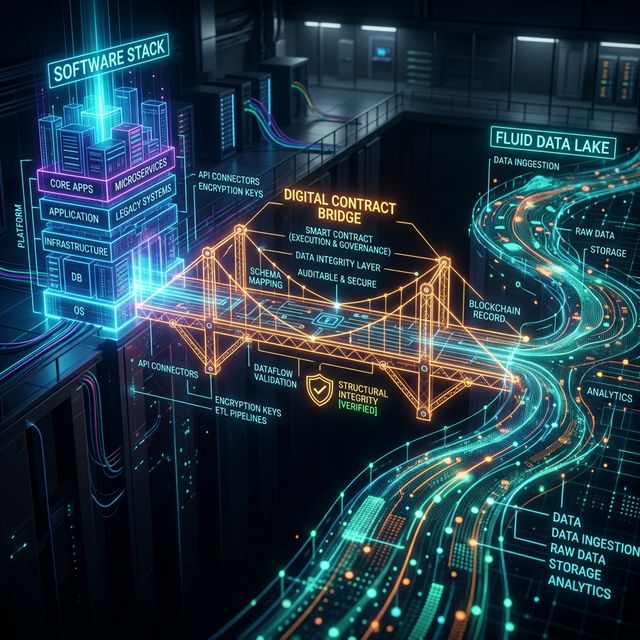
Most enterprise data downtime is not caused by complex infrastructure failures. It is caused by a software engineer dropping a database column or changing a timestamp format, entirely unaware that a downstream analytics dashboard or an ML pricing model relied on it.
This disconnect between the producers of data (software engineering) and the consumers of data (data engineering and ML teams) costs enterprises millions in broken pipelines and delayed intelligence. The solution is transitioning from undocumented assumptions to explicit Data Contracts.
The Wild West of Data Extraction
In the typical architecture, data engineers rely on bulk extraction tools (like Fivetran or Debezium) to pull data directly from the operational database into the data lake.
This creates a massive fragility: the operational database schema is treated as the public API. But software engineers own that database, and they rightfully alter schemas daily to push new application features. When they deploy a change that splits the full_name column into first_name and last_name, the downstream ETL job instantly fails.
Establishing the Contract
A Data Contract guarantees that the data produced by a service matches an explicitly defined, versioned schema before it ever enters the analytical pipeline.
- Schema as Code: The contract is written in YAML or JSON Schema and stored centrally in Git. It defines the exact shape of the data the service guarantees to emit (e.g., “The
user_signupevent will always contain a non-nulltimestampformatted as ISO-8601”). - CI/CD Enforcement: If a software engineer pushes a pull request that accidentally removes a contracted field, the CI/CD pipeline aggressively fails the build. The change cannot be deployed to production if it breaks the contract.
- Decoupled Evolution: When the business legitimately needs to change the data structure, they version the contract. The data engineers construct code to gracefully migrate from v1 to v2 on their schedule, preventing sudden outages.
Data Contracts legally bind your software and data domains together. Without them, your AI models are constantly one app deployment away from starving.